

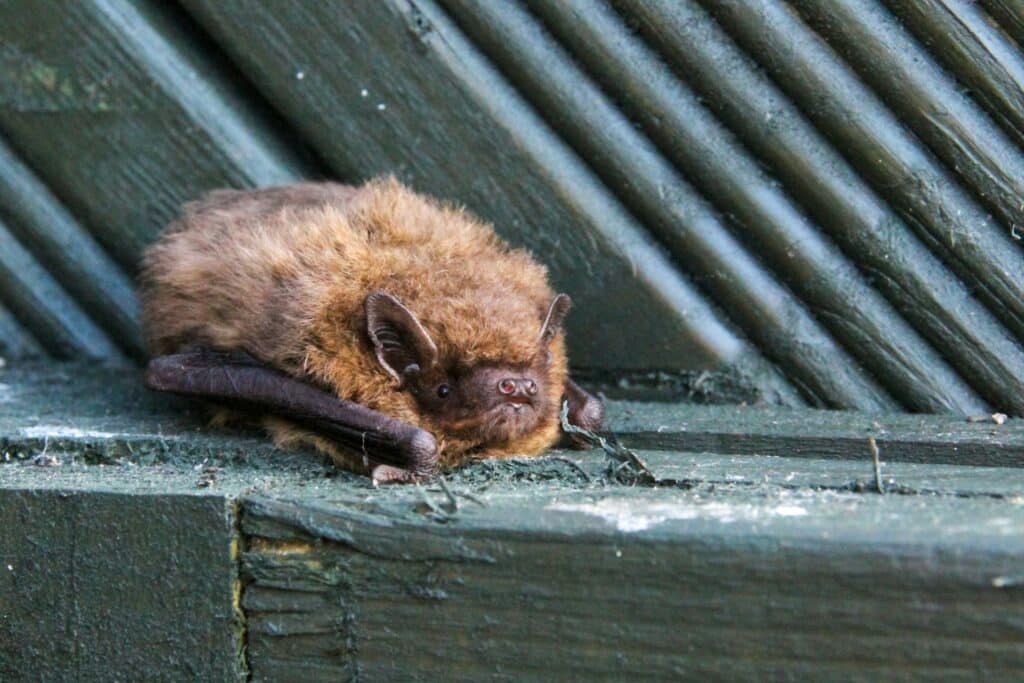

Bats are the second-largest order of mammals after rodents, with a staggering 1,400 distinct species, 47 of which live in the United States
There is a tremendous amount of diversity among US bats, especially in size, though blood-consuming species like vampire bats are not found here. The smallest is the western pipistrelle, which grows to 2.5— 3.5 inches, with an 8-inch wingspan; this tiny bat weighs less than a penny. The largest U.S. bat is the greater mastiff bat, which can grow to seven inches or more, with a wingspan of over 21 inches.
Bats also hold the distinction of being the only mammals in the world capable of flight, often navigating through the night using echolocation. In order to make flight possible, bats digest food at a speedy pace, sometimes excreting within 30 to 60 minutes after eating. This helps them keep their weight down so their aerial maneuvers are as easy as possible.
Bat Lifespan
In temperate climates, bats usually give birth between May and July. Gestation can take anywhere from six weeks to six months.
Bats give birth to live young, one pup at a time, which they nurse with milk until the pup can eat on its own. When bats are born, the pups are blind and helpless. A baby bat clings to its mother fiercely at first, and the mother only leaves for short periods in the evening to hunt.
Bats often gather in maternity colonies during their birthing season. The birthing season runs from late May to about mid-August. Maternity colonies are basically groups of female bats who come together to take turns raising their young.
As pups grow and develop, mothers slowly increase their hunting time to wean their offspring. Once the baby bats are about five weeks old, they begin to fly and hunt but may still nurse until they can feed on their own.
How Long Do Bats Live?
Most bats live less than 20 years in the wild, but six species can live more than 30 years!
When a baby bat is born, it is blind and virtually helpless. They rely totally on their mother until they are about five weeks old, when they can begin flying and hunting. Some species reach full size as quickly as two months.
Since baby bats are completely reliant on their mother and have little to no capacity for self-preservation, many of them die from accidents while flying or falls from high nesting places. Many bats do not live to maturity.
Once bats mature, though, their mortality rate drops significantly. Bats have few natural predators and can live a very long time; although most bat species live less than 20 years in the wild, scientists have identified six species that live more than 30 years. In 2006, one tiny bat from Siberia reached the ripe old age of 41—far exceeding the average lifespan of most wild species and matching the average life expectancy of an American, circa 1885!
Some bats return to the safe roost year after year. So if you have bats in your attic, it could become a 30-year problem.
Threats to Bat Lifespan
Bats are vulnerable because most species produce only one pup a year. Bat populations recover slowly, especially with threats from disease and habitat loss.
White-Nose Syndrome
- One of the most serious threats is white-nose syndrome, a fungal disease that affects hibernating bats. Infected bats wake up repeatedly during winter, burn through their fat reserves, and often die before spring. The disease has killed millions of bats in North America
Habitat Loss
- Urban development, deforestation, and land clearing can destroy the trees, caves, and other roosting sites bats rely on for shelter and raising young. Habitat loss can increase stress, reduce food availability, and expose bats to predators.
Roost Disturbance
- Human activity in caves, buildings, attics, or bridge roosts can disrupt bats during critical periods such as hibernation and maternity season. Frequent disturbance may cause bats to abandon roosts or expend energy needed for survival.
- Wind Turbines
- Some bat species are killed when they collide with wind turbine blades or experience internal injuries caused by rapid air-pressure changes around the spinning blades. Migratory bats are particularly vulnerable.
Where Do Bats Live?
Bats are found throughout the United States, Puerto Rico, and the US Virgin Islands. The Hawaiian Hoary bat is the only native, terrestrial mammal on the Hawaiian Islands.
Bats can be found in almost every kind of habitat. They live in deserts, woodlands, caves, suburban communities, and cities. Bats’ natural habitat usually takes the form of caves, or holes and gaps in rocks, as they provide ample protection from predators.
Bats are also known to live in trees, but they do so reluctantly, as they are more exposed than caves and structures. Bats hang upside down to simply drop into the flight instead of getting a running start and taking off. They need a location with rough surfaces that they can hang from, as well as a certain amount of height and width to allow them to both enter into flight and land.
Bats will also readily inhabit human structures such as attics, mines, bridges, and chimneys. Perhaps the most famous bat roost in the US is the Congress Avenue Bridge in Austin, Texas. According to Bat Conservation International, between 750,000 and 1.5 million bats reside under the bridge each summer, and the evening spectacle of them flying out from underneath the bridge in search of food attracts as many as 100,000 tourists annually.
Many of the qualities bats value in a habitat—such as security from predators, space, and proximity to food and water—can be found in human structures, and as many homeowners already know, bats have no reservations about setting up shop in your house.
Several signs can indicate bats are present. One is a persistent, musty, ammonia-like smell from bat feces. Another sign is the droppings themselves, which are small cylinders, usually crumbly in texture and tapered at the ends. Yet another sign of a bat infestation is oily stains on the walls of the roost site. Bats secrete oil through their chest, and when they rub against the walls of the roost site, the oil is imparted to the wall. These stains start as discolorations but, over time, become dark, oily stains.
How Long Do Bats Live in My House?
Bats in the Summer
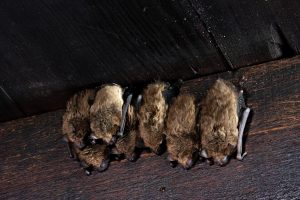
Maternity colonies will live in your attic, walls, or chimney for two to three months. This typically ranges from May to August. Once the pups are big enough to fly on their own, the colony will fly off.
Bats Hibernating in the Winter
According to the National Park Service, some species, like the little brown bat, may hibernate for around six months while awaiting the return of insects in spring, while other species–usually those that roost in trees, such as hoary bats–migrate south for the winter while insects are scarce.
Bats prefer to hibernate in dark, humid areas like caves and mines. When these natural areas or man-made bat houses are unavailable, bats may choose human structures like barns, sheds, chimneys, or even attics.
A bat infestation can be a serious problem because bats commonly carry rabies, and their droppings may promote the growth of histoplasmosis. For this reason, direct contact with bats should always be avoided. If you hear what you believe to be bat noises in your home, or have noticed bat excrement, contact Trutech Wildlife. Our team has the knowledge and resources to assess and resolve the situation quickly and safely.
Bat Removal Near You

Bats in Jacksonville, FL
There are 13 species of bats in Florida; several of these, including little brown and big brown bats, may be found in residential homes and
Bats in Tampa-St Petersburg, FL
Florida is home to thirteen bats, and all of them eat insects. Residents in Tampa Bay can experience incredible benefits from bats on their property.
Bats in Orlando, FL
Bats are found in nearly every geographic region in Florida. Their favorite environments include tropical forests, woodlands and open fields. Natural roosting spots include caves,

Bats in Kansas City
Kansas is home to fifteen species of bats, and all of them are insectivores. Bats in Attic in Kansas City Bats in Kansas naturally roost
Bat Removal in Northeast Ohio
There are eleven species of bats commonly found in Ohio. The solitary species are the hoary bat, the silver-haired bat, and the Eastern red bat.
Bat Removal in Raleigh
The most humane way to get rid of bats is to let them evict themselves. A bat valve allows bats to fly out of your