


Key Takeaways:
There Are Likely More Mice Than You Think. Mice reproduce quickly, and a few store-bought traps may not be enough to control an infestation. Effective control requires using enough traps to address the size of the mouse population.
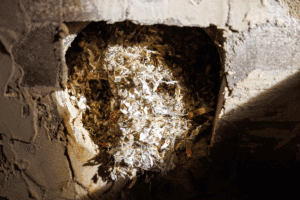
Mice Hide in Hard-to-Reach Places. Mice build nests near food sources, often inside walls, above ceilings, under floorboards, and in attics. Finding nests and placing traps along established runways near food sources improves control.
Mice Are Cautious and Follow Established Routes. Mice rely on familiar paths along walls, floorboards, pipes, and wires. They may avoid unfamiliar traps or bait, so successful trapping requires strategic placement, effective bait, and patience.
Trapping Alone Won’t Prevent Future Infestations. Mice leave behind urine, droppings, nesting materials, and scent trails. Without sealing entry points and removing nests and contaminated materials, new mice can continue entering your home. Effective long-term control combines trapping, exclusion, and cleanup.
Jump in Article
DIY mouse control usually fails because your control strategy isn’t aggressive enough. A few store-bought mouse traps placed in your kitchen will probably catch a few mice, but it won’t be enough to control the population.
Consider:
- Where mice nest
- How mice move through your house
- What are the mice’s feeding habits in your house
- How many mice are living in your house
- Where mice get into my home
There Are More Mice in Your House Then You Think
Mice have a short gestation period, breed frequently, and reach sexual maturity early. After one month, one or two mice can quietly double or triple.
Your home provides ideal conditions for a mouse colony to grow rapidly. They have plenty of food, shelter from the elements, and few to no predators. If you’ve found evidence of a mouse, assume many more are hiding inside your home.
Most homeowners don’t set enough mouse traps to control a mouse problem.
What We Do
- Identify how many mice are present
- Set appropriate amount of traps
Where Are Mice Nesting?
Mice build nests to rest, stay warm, and rear young, usually within 30 feet of food. Nests can be above ceilings, under floorboards, behind walls, and in the attic.
If you’ve found evidence of mouse activity, imagine a 30-foot sphere as the potential mouse nesting area.
Note: If you see signs of mice more than 30 feet away, you might have several mouse colonies in your home!
What We Do
- Identify all nest locations
- Safely remove and clean up nests
What Is the Mouse Food Behavior?
Mice nest close to food sources and use well-defined runways, especially in dark, protected areas.
Mice will travel along dark, protected runways. They use their whiskers to navigate. That’s why you’ll find runways against walls and floorboards. Excellent climbers, they can move inside walls up and down pipes, wires, and wall studs.
What Do Mice Eat?

Mice eat tiny amounts all night long. They can feed 15 to 20 times. Seeds and grains are the primary staple of a mouse diet, but they sample many food sources looking for something high in fat, protein, or sugar. Mice only eat about 3 grams of food per day, but they contaminate much more than that. Mice nibble and discard partially eaten food.
If you have found food nibbled on by a mouse, discard it immediately. Do not try to test or salvage food. If mouse droppings are present, follow proper precautions to clean up the area.
Note: Store food in glass, heavy-duty plastic, or metal containers to stop mice.
What We Do
- Set mouse traps near their food sources
- Use highly effective baits
Why Are Mice Avoiding the Traps?
Mice are curious but cautious. They investigate every change in their territory.
Mice repeatedly follow the same route and rely on a subconscious record of movements to travel through your house. If their environment changes, mice will slowly re-explore the territory and investigate every object, new and old, as they learn a new route.
What We Do
- Place traps in several areas near evidence of mice activity
- Use more than one trap
- Check traps consistently for signs of activity
- Use effective baits
How Mice Communicate
Mice will communicate with each other usually through pheromones. They produce a musky odor that humans can detect. Pheromones can be found in urine, feces, and emitted from glands on the mice
Mice use pheromones to communicate their location, mating, dam-pup interactions, and the presence of food. Even after the rodents are eliminated, pheromone trails can still signal to other mice safe places to find food. If you leave those gaps open in your house, it’s an unobstructed highway into your home.
What We Do
- Seal all entry gaps to stop mice from entering
- Remove materials contaminated with urine and feces
- Remove and dispose of nests
- Apply sanitization and deodorizing agents
Call Trutech In to Get Mice Out
Mice can get into any home, regardless of style or condition. Mice can squeeze through tiny holes, and their sharp incisors can gnaw through most materials in a house. Because they can get into anyone’s home and reproduce rapidly, controlling a mouse infestation on your own can be difficult.
We’ve been protecting our neighbors’ homes from rodent infestations for decades. We have the knowledge and skills to exterminate mice from your property and protect your home from future infestations.
Local Mouse Control Near You
Sources
- The Role of Pheromonal Responses in Rodent Behavior: Future Directions for the Development of Laboratory Protocols
- Surveillance and Management of Common Structure-Invading Mice
- Biology and Behavior of Common Structure-Invading Mice
- Nest-building behavior in laboratory mice: Multifunctional roles and neural mechanisms
- Controlling House Mice

What to Do When You Find a Mouse Nest in the House
Key Takeaways Mice nest close to a food source and create nests from a variety of materials found inside and outside your house. Mice nest

How to Identiy a Mouse Infestation
Quickly identifying the signs of a mouse infestation is crucial. Noticing the sign of one mouse usually means there are many mice. Mice reproduce at

Rat Droppings vs Mouse Droppings
Discovering mice or rat droppings in your home is, unfortunately, a common household problem that needs immediate attention. They gravitate to homes where they can

Will Homeowners Insurance Cover Wildlife Removal?
Watching a wild animal in your backyard can be quite the experience. Squirrels chasing each other through the trees is cute. Seeing a black bear

How to Tell the Difference Between Rats and Mice
If you’re hearing strange scratching or scurrying noises in your walls, or perhaps have noticed some small droppings in the kitchen, laundry room, or basement,

Where Do Mice Hide?
It is well known that mice have an affinity for human structures–it is often said that wherever humans are, mice are likely to be. But